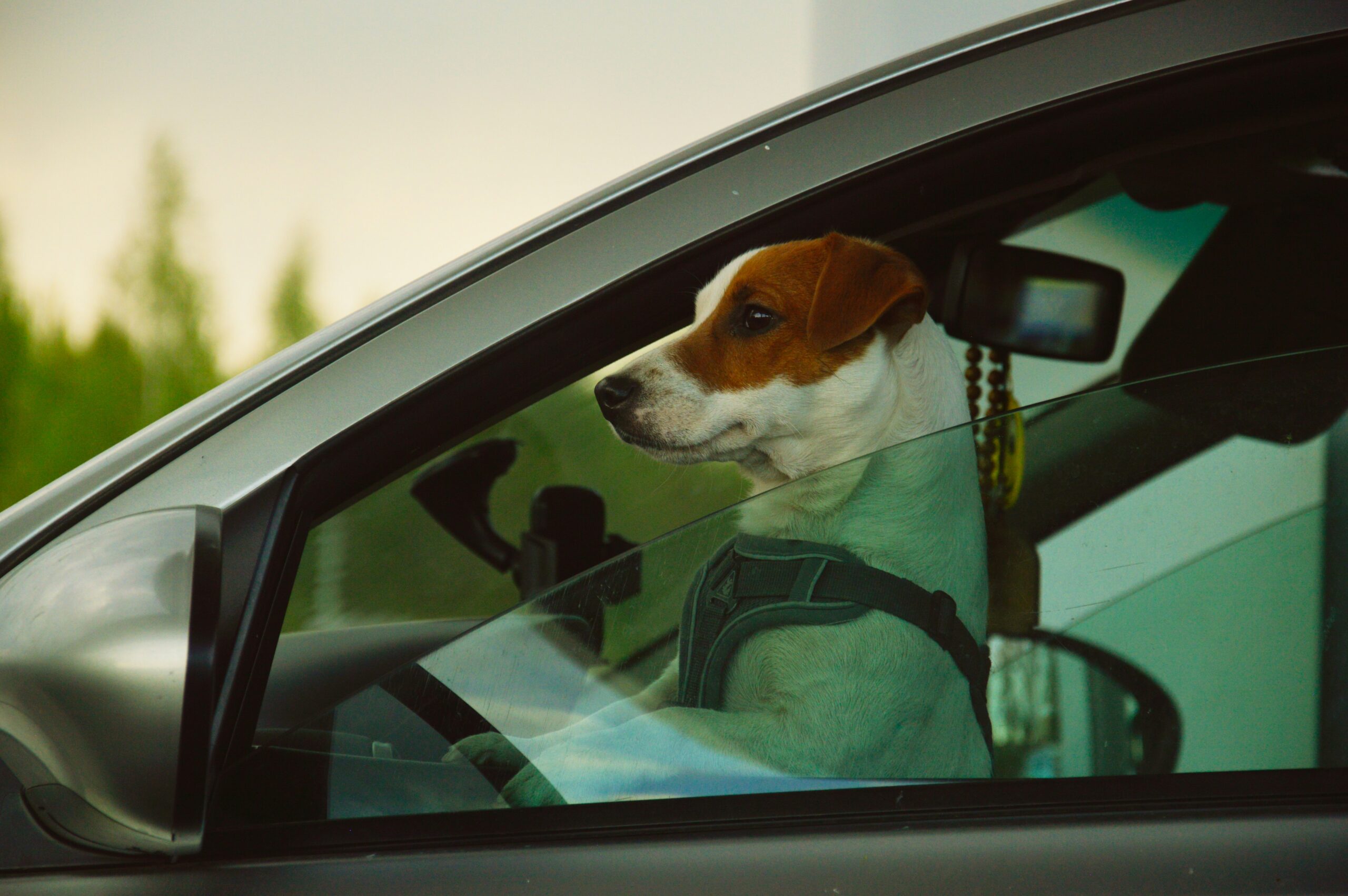
Road trips are often the easiest way to travel with your dog. Scenic highways, long stretches of open road, roadside dhabas, and the flexibility to stop when needed make car travel far more manageable than trains or flights. But Indian roads present unique risks: sudden braking, pothole-riddled highways causing abrupt jolts, and aggressive overtaking on national highways. Keeping your dog safe requires specific accessories like a dog car harness. It prevents your dog from becoming a projectile during emergency braking or collision. Yet most dog car harnesses sold in India prioritisze appearance over safety.
In this guide, we explained the types of dog car harnesses, essential features, and how to choose one for Indian road conditions.
Why a Dog Collar Is Unsafe for Car Travel
Attaching a tether directly to your dog’s collar during car travel creates concentrated pressure on the neck and trachea. During sudden braking, common on Indian highways, your dog’s forward momentum transfers entirely to this single contact point.
For small breeds, this can cause tracheal collapse or neck injury. For larger dogs, the force during a 60 km/h emergency stop is sufficient to break collar attachments or cause cervical spine damage. Collars offer no restraint against forward movement.
Indian traffic conditions amplify this risk. Stop-and-go congestion, unexpected speed breakers, and frequent hard braking mean more forward movement than normal.
The risk can be mitigated by a properly designed harness that distributes force across the chest and shoulders. In a well-designed dog harness, the restraint point sits between the shoulder blades, allowing the harness to absorb and spread impact force across the ribcage.
Types of Dog Car Harnesses for Indian Roads
Dog car harnesses are usually categorised by how their straps are designed and how restraint force is handled. Knowing these basic types helps you understand what you’re actually buying when browsing online or in-store.
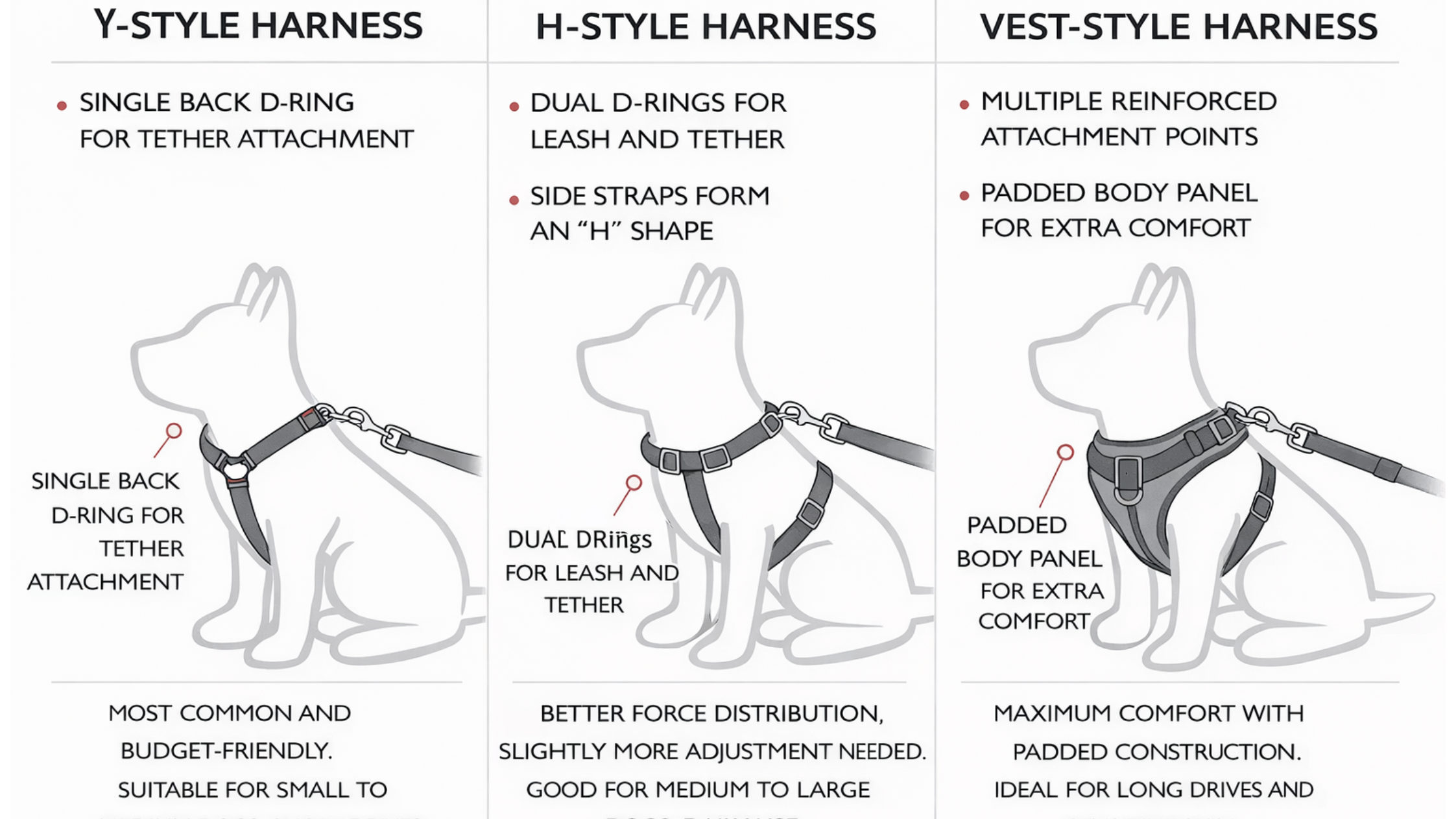
1. Seat-Belt Clip Harness (Most Common)
These are the most widely used dog car harness types in India. The harness wraps around the chest and back, with a D-ring on the back where a tether clips into the car’s seat belt buckle. The car’s seat belt locking mechanism acts as the anchor.
Designs you’ll see in this category:
- Y-style dog car harnesses: Single back strap with chest support. Common and affordable.
- H-style harnesses: Side straps with chest and back bands. Offers slightly better force distribution.
- Vest-style harnesses: Padded panels covering more of the chest and back for comfort.
These design differences affect fit, comfort, and ease of use, not crash safety.
How the Seat-Belt Clip Harness works: During sudden braking, the seat belt limits forward movement if the dog harness is properly fitted.
Appropriate for: Short to medium drives (under ~200 km), city commutes, dogs under 20 kg, and cars with accessible rear seat belt buckles.
Limitations: Safety depends heavily on material quality and fit. Budget versions use thin straps that stretch or fail. Most seat-belt clip harnesses sold in India are not crash-tested.
2. Crash-Tested Harnesses (Limited Availability in India)
Crash-tested harnesses are evaluated by independent bodies to measure restraint performance during simulated collisions.
How the Crash-Tested Harnesses work: They use reinforced webbing, stronger stitching, and multiple body contact points designed to handle impact forces rather than just restraint.
Appropriate for: Highway driving, long-distance travel, and larger dogs (20 kg+). Preferred by pet-parents who prioritize maximum safety.
Limitations: Availability in India is extremely limited. Most models require importing and cost ₹4,000–₹8,000 after duties. Proper sizing is difficult without physical trials.
As of 2026, fewer than five genuinely crash-tested harness models are easily available in India. Products claiming to be “crash-tested” at very low prices are usually marketing claims without verification.
3. Step-In vs Over-the-Head dog car Harness (Fit Preference)
This is not a safety category, but a wearing style that applies mainly to seat-belt clip harnesses.
- Step-in harness: The dog steps into loops, harness clips over the back.
Best for anxious dogs and quick daily use. - Over-the-head harness: Slips over the head, then the straps secure around the chest.
Best for larger dogs and more stable fits.
A step-in harness for your dog is safer in practice than an over-the-head design, which you struggle to put on and eventually stop using.
Note: Products sold as “dog seat belts” or “car safety leashes” are usually tether-only restraints. These are not harnesses and should not be confused with crash-distributing designs. When attached to a collar, they pose a serious risk of injury to your dog’s neck. They limit movement but do not provide impact protection and are unsuitable for highway travel.
Dog Car Harness Comparison at a Glance
| Harness Type | Restrain type | Useful for | Limitations | Availability in India |
| Seat-Belt Clip Harness (Y / H / Vest styles) | Harness distributes force across chest and back; tether clips into car seat belt | Short to medium drives, city travel, dogs under 20 kg, most Indian cars | Safety depends on fit and material quality; most are not crash-tested | Widely available |
| Crash-Tested Harness | Reinforced harness designed to handle impact forces during collisions | Highway driving, long distances, large dogs (20 kg+), safety-first pet parents | Expensive, limited sizing options, mostly imported | Very limited |
| Step-In Design | Wearing style where the dog steps into loops; clips on the back | Anxious dogs, frequent on/off use, daily travel | Fit can shift if poorly adjusted | Common |
| Over-the-Head Design | Slips over the head; straps secure under the chest | Larger dogs, stable fit once worn | Not ideal for dogs that resist handling | Common |
| Tether-Only “Dog Seat Belts” (Not a harness) | Movement is limited by the tether, not the harness structure | Very short, low-speed city drives only | No impact protection; unsafe for highways; dangerous if attached to the collar | Widely sold (often misleadingly) |
How to Choose the Right Dog Car Harness
- Metal buckles and D-rings: Plastic cracks under heat and breaks under force, whereas metal can withstand both.
- Padded chest plate: Distributes pressure evenly, prevents chafing, and reduces heat build-up, whereas thin straps dig into skin.
- Sizing by chest girth: Measure the widest part of the chest (behind front legs). Don’t rely on weight-based sizing alone.
- Multiple adjustment points: Neck, chest, and belly straps should adjust independently. Dogs gain/lose weight seasonally.
- Car compatibility: Check your seat belt buckle placement. Recessed buckles need longer tether attachments.
- Easy on/off: Look for single or two-buckle systems that you can fasten in under 30 seconds. Ease of application guarantees regular use.
What to Avoid while Buying Dog Car Harness
- Plastic buckles that flex with thumb pressure
- Decorative harnesses without technical specifications
- One-size-fits-all claims
Harness Fit for Indian Car Types
| Car Type | Harness Considerations |
| Hatchbacks (Swift, i10, Tiago) | Compact seat, limited legroom requires smaller harnesses. Check for tether length. It shouldn’t reach the front seats. |
| Sedans (City, Verna, Ciaz) | Standard harnesses fit well. Two medium dogs’ side-by-side possible with individual harnesses. |
| Compact SUVs (Creta, Seltos, Nexon) | Harnesses work for the back seat. For boot travel, combine with cargo barriers or a secured crate. |
Fitment rule: Always check the length of the tether; it should allow sitting, lying, and standing, but prevent front-seat access. For most medium dogs in sedans, a 30–40 cm tether works.
Never use a harness in the front seat. Dogs should travel in the back seat. Make this rule non-negotiable.
Available Price Range for Dog Car Harnesses
₹800–₹1,200: Basic Restraint
Provide the most basic functionality with standard nylon and basic stitching. Suitable for short city drives, small dogs, and occasional use. Expect 6–12 months of durability. We don’t recommend it for highway speeds or large breeds.
₹1,500–₹2,500: Good Quality for Regular-Use
In this budget range, you will get thicker webbing, metal buckles, padded chest plates, and multiple adjustments. It is suitable for regular travel, dogs up to 25 kg, and moderate highway use. Lasts 18–24 months.
₹3,000+: Premium and Crash-Tested
In this price range, you will get imported models, crash-test certifications, and advanced materials. These dog car harnesses provide maximum protection for long highway travel, for larger breeds. However, price alone doesn’t guarantee safety, so it is important to verify testing claims. Design matters more than cost.
Avoid these Common Mistakes When Using Harnesses
- Attaching to the collar loop instead of the back D-ring: Redirects force to the neck, defeating the purpose of the harness. Always use the back D-ring between the shoulder blades.
- Leaving the harness too loose: Allows excessive movement, increasing force during stops. Fit: two fingers between straps and body, not three.
- Front-seat attachment: Airbag deployment risks serious injury. Dogs belong in the back seat only.
- Not adjusting for weight changes: Check fit monthly, especially for puppies or dogs on weight management.
Do You Really Need a Dog Car Harness?
You can skip the dog car harness if:
- Using a secured travel crate: A properly anchored crate serves as a protective restraint. Harness redundant.
- Very short, low-speed trips: Under 2 km at under 30 km/h with dog in back seat. Risk assessment, not absolute safety.
- Boot travel with cargo barrier: Rigid, anchored barrier (not mesh clips) contains dog in protected area.
- Very small dogs in secured carriers: Under 5 kg dogs can safely travel in hard-sided dog carriers on the floor or seat-belted on the back seat.
Frequently Asked Questions
- Can I use a dog walking harness in a car?
Most aren’t designed for car safety. If it has a sturdy back D-ring and reinforced stitching, it is acceptable for short trips. Dedicated car harnesses are better for regular travel. - Where does the tether attach?
The car’s seat belt buckle: the same buckle which you use for your seat belts. Thread the clip in, push until it clicks. Never attach to headrests or grab handles. - How tight should the harness be?
Snug but not restricting breathing. Two-finger test: slide two fingers between the straps and body. The chest plate should sit flat and centred. - Do puppies need harnesses?
Yes, if too large for a secured carrier. Adjust for current size. If you have a puppy under 3 months, a carrier is safer. - Is harness Safer than holding my dog?
Significantly. During a sudden stop at 60 km/h, a 10 kg dog generates 50+ kg pressure. You cannot hold that. Harness is non-negotiable.
Conclusion
The right dog car harness depends on your dog’s size, your car type, and travel patterns. A ₹1,800 harness with proper fit and metal hardware protects better than a ₹4,000 harness in wrong size or used incorrectly.
Measure chest girth, verify seat belt buckle access, prioritize construction quality over brand names. Choosing correctly prevents wasted money and protects your dog during unpredictable Indian road conditions.
Questions about harness fit for your dog or car? Share your situation in comments—details about size, breed, and trip types help us provide specific guidance.